Simplifying Local Government
Help shape the future of your local government
This is not a binding poll. Community feedback will help inform Council proposals, but final decisions sit with Central Government.
Change is coming to how local government works.
The Government is looking at changes to how local government works in New Zealand, with the aim of making it simpler, more efficient and easier for people to understand.
This could affect how local decisions are made, how services are delivered, and how local communities are represented, and will significantly reduce the number of councils in New Zealand.
Under the proposed changes, regional councils won’t exist after 2028, and all district councils would eventually become unitary authorities - one council doing the work currently done by both district and regional councils.
District councils generally deliver local services such as roads, rubbish collection, parks, libraries, water services and local planning, while regional councils focus on environmental management, like water quality and pest control, and public transport.
To carry out these functions effectively, it is likely that some councils will need to join together.
Our council has agreed to be part of the Government’s Head Start pathway so that we can have a say in developing our future, instead of having it done to us later.
Under this pathway, district councils can work together to develop outline proposals for new unitary authorities. These proposals can cover all or part of a region and may include the creation of one, or a small number of, new unitary authorities.
Councils only have until 9 August 2026 to submit an outline proposal.
Since the Government’s announcement on 5 May, we've been talking with other councils across the region, and it’s important we have your views as part of these conversations, while we work through what comes next.
A community survey was open from Friday 12 June to Sunday 12 July 2026. You can view a summary of the results here.

Help shape the future of your local government
This is not a binding poll. Community feedback will help inform Council proposals, but final decisions sit with Central Government.
Change is coming to how local government works.
The Government is looking at changes to how local government works in New Zealand, with the aim of making it simpler, more efficient and easier for people to understand.
This could affect how local decisions are made, how services are delivered, and how local communities are represented, and will significantly reduce the number of councils in New Zealand.
Under the proposed changes, regional councils won’t exist after 2028, and all district councils would eventually become unitary authorities - one council doing the work currently done by both district and regional councils.
District councils generally deliver local services such as roads, rubbish collection, parks, libraries, water services and local planning, while regional councils focus on environmental management, like water quality and pest control, and public transport.
To carry out these functions effectively, it is likely that some councils will need to join together.
Our council has agreed to be part of the Government’s Head Start pathway so that we can have a say in developing our future, instead of having it done to us later.
Under this pathway, district councils can work together to develop outline proposals for new unitary authorities. These proposals can cover all or part of a region and may include the creation of one, or a small number of, new unitary authorities.
Councils only have until 9 August 2026 to submit an outline proposal.
Since the Government’s announcement on 5 May, we've been talking with other councils across the region, and it’s important we have your views as part of these conversations, while we work through what comes next.
A community survey was open from Friday 12 June to Sunday 12 July 2026. You can view a summary of the results here.
-
Stratford backs two-council proposal for Taranaki's future
Share Stratford backs two-council proposal for Taranaki's future on Facebook Share Stratford backs two-council proposal for Taranaki's future on X (formerly Twitter) Share Stratford backs two-council proposal for Taranaki's future on Linkedin Email Stratford backs two-council proposal for Taranaki's future linkSouth Taranaki and Stratford District Councillors voted this week to support a proposal for two unitary councils covering Taranaki as part of the Government’s Head Start pathway for simplifying local government.
The preferred option was for the South Taranaki District Council and Stratford District Council to amalgamate to form one unitary authority which takes on both district council and regional council functions for southern and central Taranaki.
South Taranaki District Mayor Phil Nixon says the decision reflects a strong and consistent message from the south and central Taranaki communities, iwi partners and key stakeholders that local voice, local decision-making, and local control over the services provided must be protected through any future local government changes.
“Our community has been very clear. People understand change is coming, but they do not want south or central Taranaki’s voice to be lost in a single, region-wide council,” says Mayor Nixon.
Mayor Nixon’s comments were supported by strong community feedback which saw 1,392 responses being received through South Taranaki’s Head Start survey, with an overwhelming 94% supporting a two-council model. Stratford District Council’s survey reflected similar results with 83% of the 633 responses also supporting a two-council model.
“This decision gives us a clear position to take into the next stage of the Head Start process. It supports change where change is required, but it also recognises that Taranaki is not one single community with one set of needs, priorities or interests.”
Stratford District Mayor Neil Volzke says the two Councils’ preferred model is a balanced approach.
“It would simplify local government in Taranaki, while keeping decision-making closer to the communities most affected by those decisions. We believe a Stratford and South Taranaki unitary council would better reflect the needs of our rural and smaller-town communities, while still allowing regional functions to be managed in a coordinated way where that makes sense. As we develop our proposal we want to continue to work collaboratively with New Plymouth District Council and the Taranaki Regional Council to ensure that existing regional functions that need to continue being delivered regionally, will be.”
The Government’s Head Start pathway gives councils until 9 August 2026 to submit outline proposals for new unitary councils. Unitary councils combine the responsibilities currently carried out by district or city councils and regional councils.
Mayors Nixon and Volzke stressed their Councils’ decision does not create a new council or make any immediate changes to services, rates, representation, or staffing.
This is about confirming our preferred option so we can continue to work together to develop an outline proposal that we will submit to Government by 9 August. Any proposal would still need to be considered by Government, and there would be a great deal of further work, analysis and engagement before any final decisions are made.
“We recognise that New Plymouth District Council has been considering its own position in relation to local government reform and we remain committed to maintaining a constructive regional dialogue and to working collaboratively on matters where a regional approach will deliver the best outcomes for the people of Taranaki,” says Mayor Volzke.
South Taranaki and Stratford District Councillors voted this week to support a proposal for two unitary councils covering Taranaki as part of the Government’s Head Start pathway for simplifying local government.
The preferred option was for the South Taranaki District Council and Stratford District Council to amalgamate to form one unitary authority which takes on both district council and regional council functions for southern and central Taranaki.
South Taranaki District Mayor Phil Nixon says the decision reflects a strong and consistent message from the south and central Taranaki communities, iwi partners and key stakeholders that local voice, local decision-making, and local control over the services provided must be protected through any future local government changes.
“Our community has been very clear. People understand change is coming, but they do not want south or central Taranaki’s voice to be lost in a single, region-wide council,” says Mayor Nixon.
Mayor Nixon’s comments were supported by strong community feedback which saw 1,392 responses being received through South Taranaki’s Head Start survey, with an overwhelming 94% supporting a two-council model. Stratford District Council’s survey reflected similar results with 83% of the 633 responses also supporting a two-council model.
“This decision gives us a clear position to take into the next stage of the Head Start process. It supports change where change is required, but it also recognises that Taranaki is not one single community with one set of needs, priorities or interests.”
Stratford District Mayor Neil Volzke says the two Councils’ preferred model is a balanced approach.
“It would simplify local government in Taranaki, while keeping decision-making closer to the communities most affected by those decisions. We believe a Stratford and South Taranaki unitary council would better reflect the needs of our rural and smaller-town communities, while still allowing regional functions to be managed in a coordinated way where that makes sense. As we develop our proposal we want to continue to work collaboratively with New Plymouth District Council and the Taranaki Regional Council to ensure that existing regional functions that need to continue being delivered regionally, will be.”
The Government’s Head Start pathway gives councils until 9 August 2026 to submit outline proposals for new unitary councils. Unitary councils combine the responsibilities currently carried out by district or city councils and regional councils.
Mayors Nixon and Volzke stressed their Councils’ decision does not create a new council or make any immediate changes to services, rates, representation, or staffing.
This is about confirming our preferred option so we can continue to work together to develop an outline proposal that we will submit to Government by 9 August. Any proposal would still need to be considered by Government, and there would be a great deal of further work, analysis and engagement before any final decisions are made.
“We recognise that New Plymouth District Council has been considering its own position in relation to local government reform and we remain committed to maintaining a constructive regional dialogue and to working collaboratively on matters where a regional approach will deliver the best outcomes for the people of Taranaki,” says Mayor Volzke.
-
Community survey results
Share Community survey results on Facebook Share Community survey results on X (formerly Twitter) Share Community survey results on Linkedin Email Community survey results link633 people complete our Simplifying Local Government community survey - thank you!
Over the last month we’ve asked our community to share their views on the future of Local Government in Taranaki. We wanted to know what matters most to our community, what the opportunities and concerns for reform are, and whether there was interest in Taranaki having one unitary council or two unitary councils.
We’re grateful to everyone who took the time to complete this survey, and to the people who came to our Public Forum to speak directly with Elected Members on the topic.
Your feedback is helping shape Stratford’s voice in one of the most significant local government reform programmes we have seen in decades.
Please know that there will be more in-depth consultation as part of the next phase of this reform programme as we work through the detail of a proposal.
The next key milestone in the journey is the submission of an outline proposal to Government by 9 August 2026.
We will continue to keep you informed as this work progresses.
Survey responses
The responses on our survey showed a clear preference for retaining strong local representation and protecting Stratford’s identity, regardless of the final local government structure.
While respondents acknowledged potential benefits from reform, particularly shared services, reduced duplication and simpler governance, these benefits were outweighed by concerns about:
• Loss of local voice and decision-making.
• Stratford's needs being overshadowed by a larger urban centre.
• Rural communities being subject to urban-focused policies.
• Stratford ratepayers subsidising larger councils.
• Loss of Stratford's distinct identity, services and community assets.
The strongest sentiment was that Stratford and South Taranaki have more in common with each other than with New Plymouth, due to their rural economies, smaller populations and similar community needs.
A recurring theme was that people are not opposed to collaboration or shared services, but they want safeguards that protect Stratford's voice, funding, identity and local decision-making.
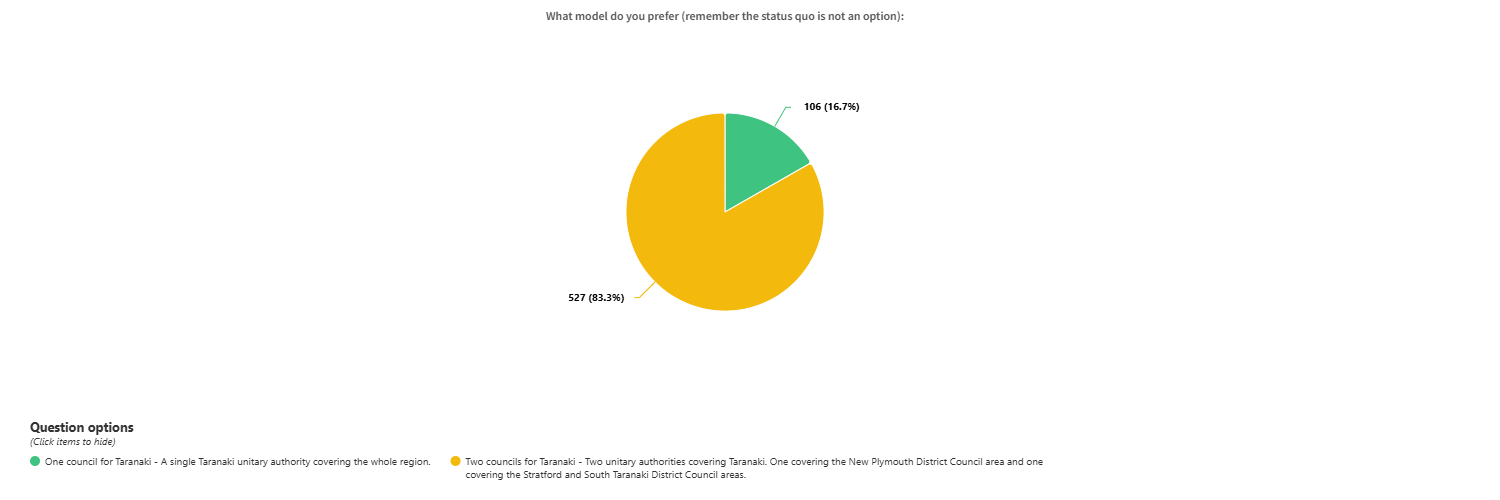
One or two councils?
- 83.3% was in favour of two unitary authorities for Taranaki (a Stratford and South Taranaki model)
- 16.7% was in favour of one unitary authority for Taranaki
Biggest opportunities?
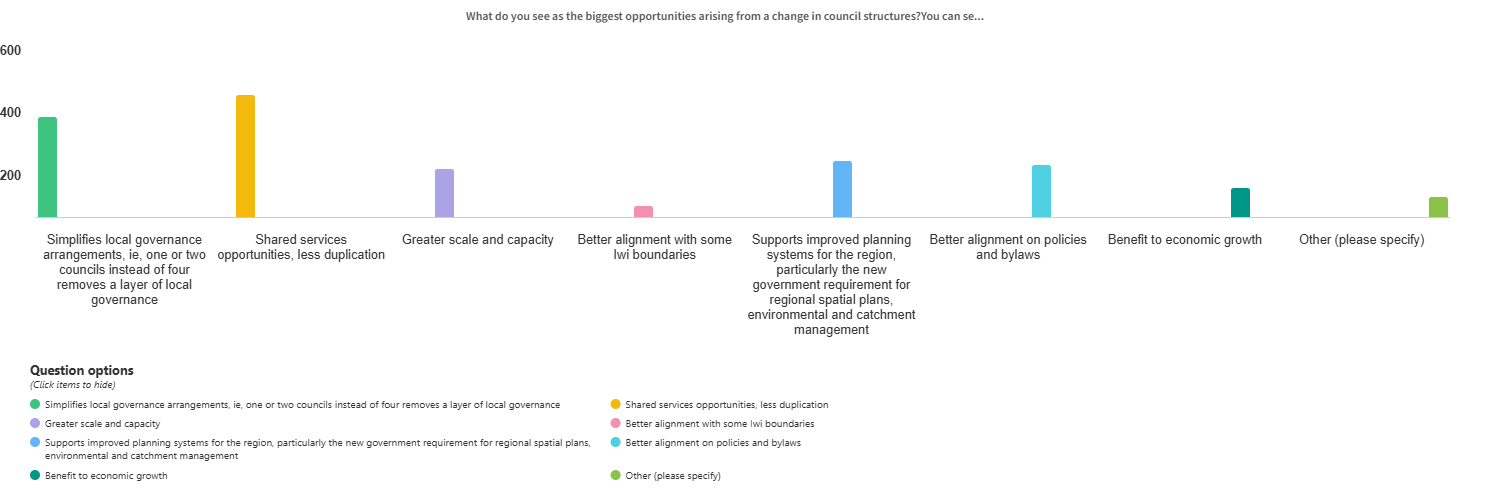
- 62.5% selected shared services
- 51.4% selected simplified governance
- 28.9% selected supports improves planning systems for the region
Biggest concerns?
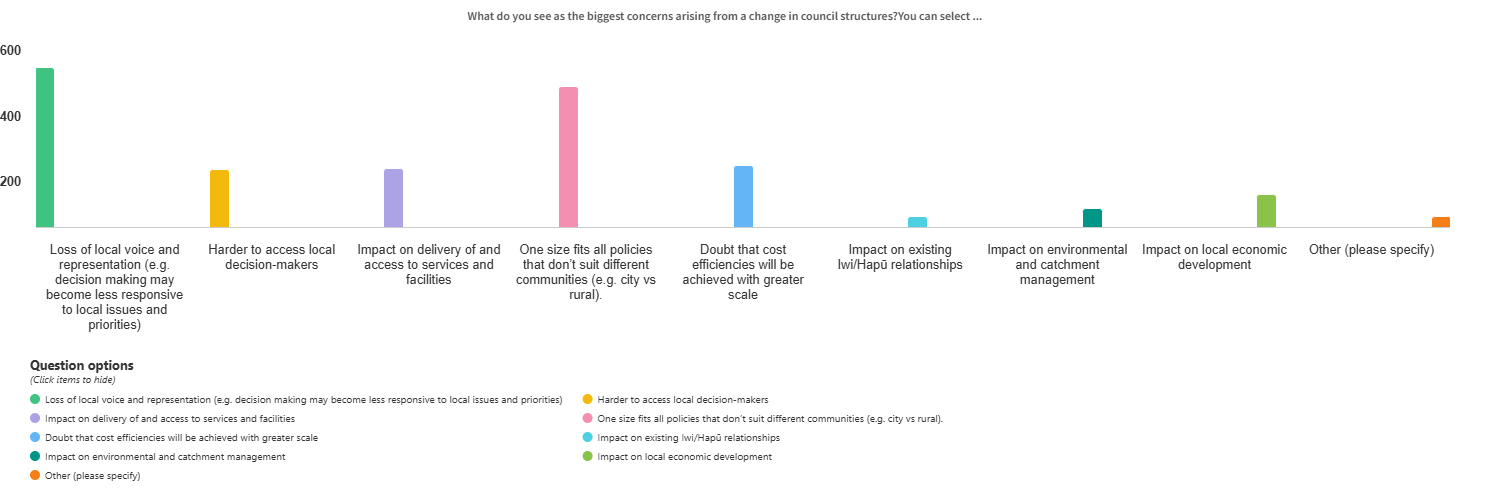
- 76.8% selected loss of local voice and representation
- 67.5% selected one-size-fits-all policies
- 29.5% selected doubt that cost efficiencies will be achieved with greater scale
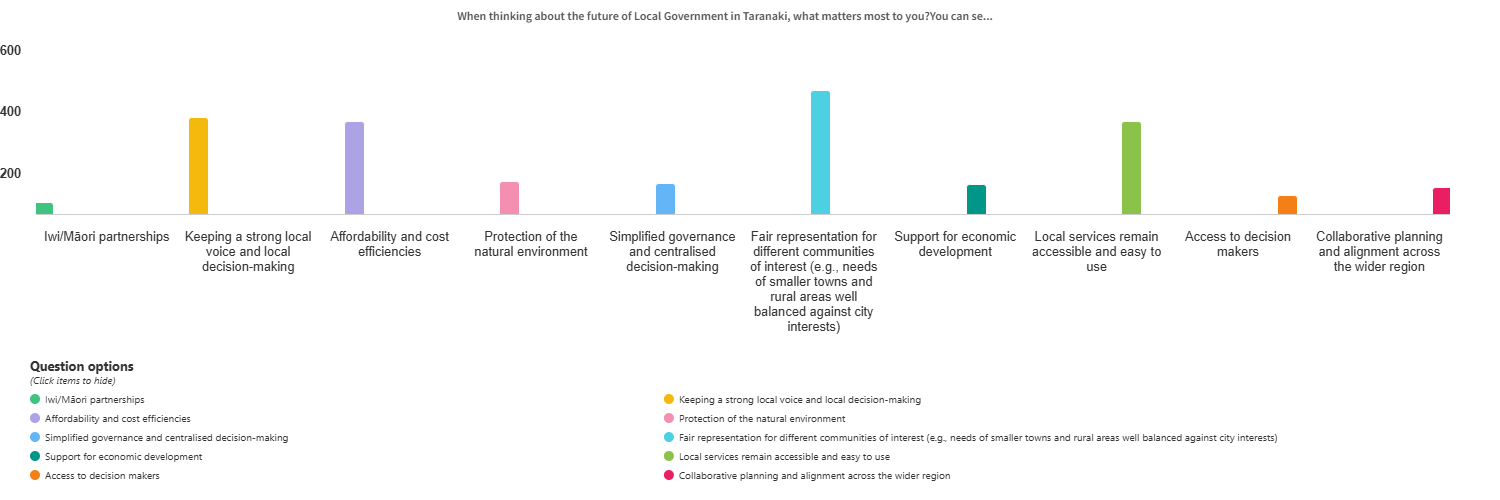
What matters most to people when thinking about the future of Local Government?
- 63.8% selected fair representation
- 49.8% selected keeping a strong local voice and local decision-making
- 47.9% selected affordability and cost efficiencies; and a close 47.8% selected local services remain accessible and easy to use
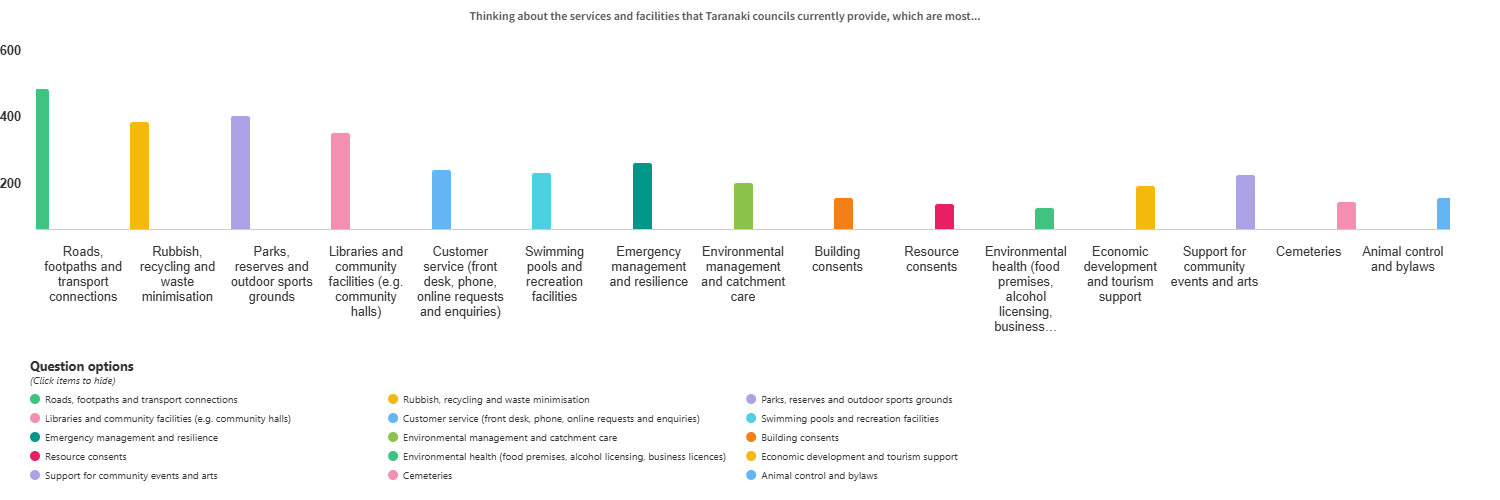
What council services and facilities matter most to people?
- 67.1% selected roads, footpaths and transport connections
- 54% selected Parks, reserves and outdoor sports grounds
- 51% selected Rubbish, recycling and waste minimisation
- 46.2% selected Libraries and community facilities
- 32% selected Emergency management and resilience
633 people complete our Simplifying Local Government community survey - thank you!
Over the last month we’ve asked our community to share their views on the future of Local Government in Taranaki. We wanted to know what matters most to our community, what the opportunities and concerns for reform are, and whether there was interest in Taranaki having one unitary council or two unitary councils.
We’re grateful to everyone who took the time to complete this survey, and to the people who came to our Public Forum to speak directly with Elected Members on the topic.
Your feedback is helping shape Stratford’s voice in one of the most significant local government reform programmes we have seen in decades.
Please know that there will be more in-depth consultation as part of the next phase of this reform programme as we work through the detail of a proposal.
The next key milestone in the journey is the submission of an outline proposal to Government by 9 August 2026.
We will continue to keep you informed as this work progresses.
Survey responses
The responses on our survey showed a clear preference for retaining strong local representation and protecting Stratford’s identity, regardless of the final local government structure.
While respondents acknowledged potential benefits from reform, particularly shared services, reduced duplication and simpler governance, these benefits were outweighed by concerns about:
• Loss of local voice and decision-making.
• Stratford's needs being overshadowed by a larger urban centre.
• Rural communities being subject to urban-focused policies.
• Stratford ratepayers subsidising larger councils.
• Loss of Stratford's distinct identity, services and community assets.
The strongest sentiment was that Stratford and South Taranaki have more in common with each other than with New Plymouth, due to their rural economies, smaller populations and similar community needs.
A recurring theme was that people are not opposed to collaboration or shared services, but they want safeguards that protect Stratford's voice, funding, identity and local decision-making.
One or two councils?
- 83.3% was in favour of two unitary authorities for Taranaki (a Stratford and South Taranaki model)
- 16.7% was in favour of one unitary authority for Taranaki

Biggest opportunities?
- 62.5% selected shared services
- 51.4% selected simplified governance
- 28.9% selected supports improves planning systems for the region

Biggest concerns?
- 76.8% selected loss of local voice and representation
- 67.5% selected one-size-fits-all policies
- 29.5% selected doubt that cost efficiencies will be achieved with greater scale

What matters most to people when thinking about the future of Local Government?
- 63.8% selected fair representation
- 49.8% selected keeping a strong local voice and local decision-making
- 47.9% selected affordability and cost efficiencies; and a close 47.8% selected local services remain accessible and easy to use

What council services and facilities matter most to people?
- 67.1% selected roads, footpaths and transport connections
- 54% selected Parks, reserves and outdoor sports grounds
- 51% selected Rubbish, recycling and waste minimisation
- 46.2% selected Libraries and community facilities
- 32% selected Emergency management and resilience

-
12 June → 12 July 2026
-
14 July 2026
-
5 May 2026
Simplifying Local Government has finished this stageCentral Government announces Head Start pathway
-
26 May 2026
Simplifying Local Government has finished this stageStratford District Council agrees to take part in the Government's Head Start pathway. Read our media release here.
-
12 June - 12 July
Simplifying Local Government is currently at this stageCommunity survey open - we're asking for you feedback. We'll take your feedback into our conversations as we work through what's next.
-
13 July - 9 August 2026
this is an upcoming stage for Simplifying Local GovernmentCouncils review feedback and determine Head Start outline proposals.
-
Tuesday 14 July at 10am: Public Forum
this is an upcoming stage for Simplifying Local GovernmentIf you wish to speak directly to Elected Members at this Simplifying Local Government Public Forum, please email your name and contact details to agenda@stratford.govt.nz by 12 noon on Tuesday 7 July. Visit Stratford.govt.nz/PublicForum for more information.
-
9 August 2026
this is an upcoming stage for Simplifying Local GovernmentHead Start outline proposals due to Government
-
September 2026
this is an upcoming stage for Simplifying Local GovernmentCabinet considers Head Start outline proposals and tells Councils which are accepted.
-
October 2026 to March 2027
this is an upcoming stage for Simplifying Local GovernmentCouncils develop detailed proposals, including community consultation period.
-
May/June 2027
this is an upcoming stage for Simplifying Local GovernmentIntended timing for final Cabinet decisions